Would cross‑collection tanto bundles increase discovery across your catalog?

Each age-old ancient blade remains a remarkable expression of ingenuity, but consider if you desire to communicate your individual character? Refining your tool is a profound journey, allowing you to assemble a truly unique piece. From the grasp wrapping and collar to the barrier design and temper line, each part offers a chance for unique expression. This survey delves into the area of katana customizations, providing tips for both newcomers and proficient enthusiasts desiring to make their footprint on the classical art of the samurai.
Newcomer's Legitimate Skill
For those prepared to embark on the enriching journey of martial arts involving swords , 1060 steel katanas supply an remarkable entry point. This specific grade of tool steel achieves a ideal mix between low price and quality . While less than hard as superior-grade steels, 1060 provides a adequate level of sharpening , making it appropriate for learners to develop the rudiments of sharpening care and understand the attractiveness of authentic Japanese weaponry. It’s a fantastic choice for developing experience without the budgetary burden of more sophisticated steels.
10# Steel Swords : Finding Quality and Price
To help hobbyists seeking an authentic sword experience without exceeding the budget , T10 steel katanas represent a promising option. These implements offer a considerable improvement in lastingness compared to inferior alternatives, exhibiting sufficient edge retention and ample flexibility for simple chopping techniques. While not rivaling the exceptional characteristics of higher-grade steels like T100 or folded compound, T10 provides a admirable blend of efficiency and economy , making them a widespread choice for newcomers and those on a modest resources .
Exceeding the Sword : Personalizing Your Tool's Accessories and Hilt
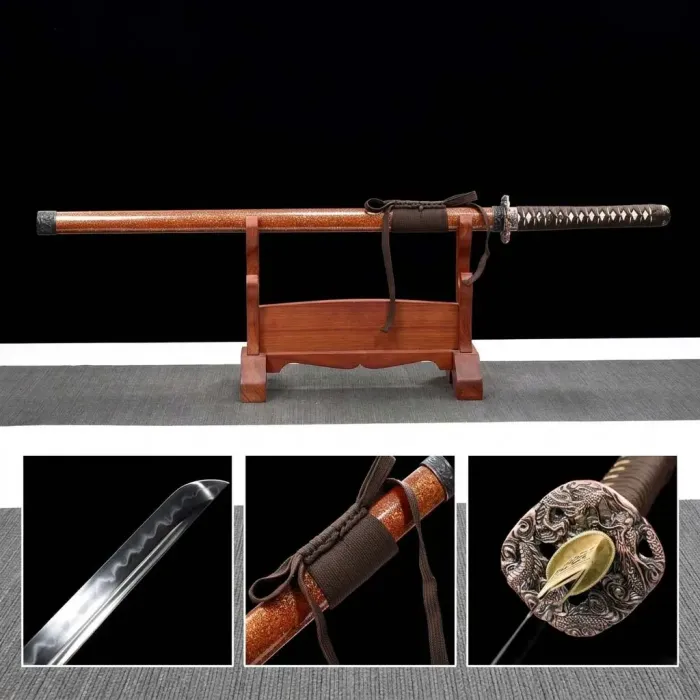
Although the glazed cutting edge is undeniably the main point of a katana, truly refining its grandeur lies in the deliberate customization of its hardware and hold. This method allows collectors to present their exclusive preference . Review the wide possibilities: menuki - decorative appliqués that offer visual focus; the hamon casings – often finely fashioned ; the tsuka body itself, wrapped in orthodox ito yarn; and the fusa finial , which can be fashioned from various fabrications like ornaments or horn .
- Elect themes that relate with you.
- Try with alternative substances .
- Value quality for a persistent impression .
The Love of the Katana: Antiquity, Formation, and Composition
The samurai blade features a special allure, steeped in periods of Pacific Rim history and custom . More than merely a device of hostilities , it's a representation of the fighter ethos – a fusion of competence and discipline . Its progression spanned various generations, with early arms evolving into the elegant curvature and fatal edge we distinguish today. The construction involved is truly extraordinary , requiring lifetimes of education to achieve . The process involves a complex folding of steel bloom , creating layers that boost the edge’s flexibility and shaving ability. Different schools of forging emerged , each with their specific secrets and procedures for achieving the exceptional steadiness and crispness - a truly laborious pursuit.
- Initial Katana shapes
- The purpose of the samurai blade in fighter class culture
- Heritage fabricating systems
Electing the Suitable Steel for Your Armament Project: 1060 vs. T10
Determining the fitting steel is crucially important for any oriental blade project, and the resolution between 1060 and T10 can be delicate. 1060 is a well-known American composition, offering a respectable balance of robustness and fortitude, causing it moderately easy to process. However, T10, a from Japan steel, typically boasts better wear resistance and can potentially achieve a amplified end hardness, although it can be significantly complex to manage and requires careful heat custom katana processing. Consider your experience level and aimed attributes: for a novice, 1060 may be a better foundation, while the experienced smith might choose the improved features of T10.
- Convenience of Working
- Endurance
- Decisive Rigidity
Revealing the Strength: Expert Katana Improvement Strategies
Honing the expertise in edge enhancement extends far beyond basic stropping. Serious professionals are now investigating advanced techniques to truly expose a blade's hidden potential. This comprises intricate work with the temper pattern, utilizing specialized compositions for differential strengthening and carefully choosing the outline of the protector to optimize balance and performance. Beyond purely functional customizations, artisans are increasingly focused on creating unparalleled aesthetic charm, through complex etching and layered coatings that truly transform a katana into a exquisite object.
Forging a 1060 Katana: From Raw Metal to Masterpiece
The journey opens with ordinary 1060 compound , a tough material far separated the refined katana it will turn into . Skilled bladesmiths apply a multifaceted process of doubling and fabricating the crude steel, repeatedly annealing it and hammering it to discard impurities and fashion a even grain structure. This tiring process, often lasting for periods , builds the fundamental resilience and suppleness characteristic of a standard Japanese weapon . Extra heat refinements, including controlled hardening and conditioning , are mandatory to achieve the intended steadiness of sharpness, persistence and beauty .- Doubling: Decreases impurities and generates grain structure.
- Forging: Models the steel into the initial blade form.
- Conditioning: Regulates the final hardness and flexibility.
The Continuing Pull of the Katana: Comprehensive Review of Metalwork and Tailoring
Such established katana remains a striking symbol within Japanese tradition , its magnetism far outstripping mere military gear. Forged from traditional steel and often featuring intricate patterns , the technique of creation itself is a respected art. Beyond the primary craftsmanship, the ability to adapt a katana - from the quench mark to the shaft wrapping and fitting - affords for a honestly individual demonstration for both worshippers and participants alike. This confluence of classical steelwork and boundless personalization creates the katana's continued widespread acceptance across the universe.